Issuance Is Solved: Any Asset Manager Can Put a Fund On-Chain Today
Over the last decade, financial markets have digitized many operational layers, from electronic trading to algorithmic settlement. Asset issuance has remained complex. Launching an investment vehicle traditionally required custodians, administrators, transfer agents, compliance teams, and settlement networks.
Current tokenization infrastructure
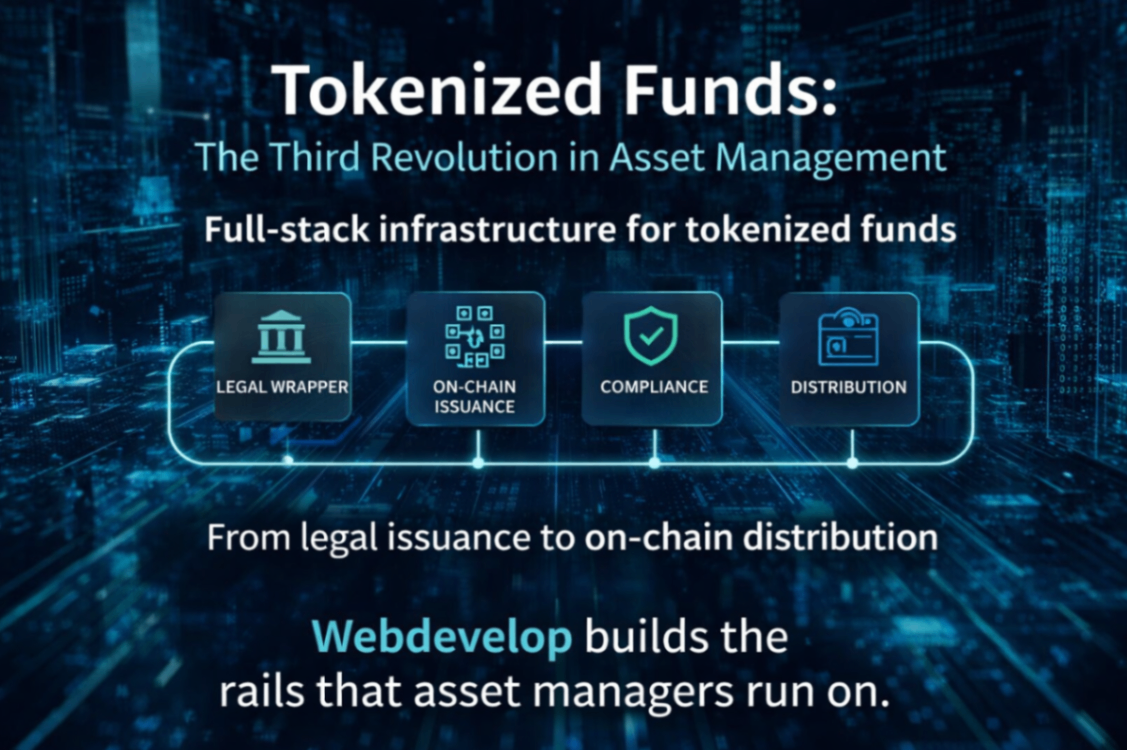
Modern tokenization infrastructure can let asset managers issue regulated investment products on blockchain rails while preserving the legal and regulatory structures required by traditional finance. Platforms such as ours provide a full-stack environment for launching, managing, and distributing real-world assets (RWAs) on-chain. With the right product, providers, and approvals, an asset manager can put a fund on-chain.
Tokenization: A Structural Upgrade to Capital Markets
Tokenization does not fundamentally change the nature of the asset. A bond is still a bond, a fund is still a fund.
What changes is how ownership and operations are represented and managed.
In a tokenized system:
- Ownership is represented by blockchain tokens
- Transfer rules are encoded directly into smart contracts
- Settlement occurs in real time
- Investor records are maintained on-chain and in synchronized ledgers
This connects parts of the traditional workflow to programmable financial rails.
Smart contracts can automate many functions that previously required intermediaries, including:
- coupon or dividend payments
- redemption schedules
- investor record management
- transfer restrictions and regulatory controls
These functions can reduce manual work and support faster settlement, subject to the product and provider setup.
From Infrastructure to Platform: The Rise of Full-Stack Tokenization
Early blockchain projects focused primarily on token standards. Institutional adoption also requires operations around the token contract.
A modern issuance platform must provide an integrated system that includes:
- issuer administration tools
- investor onboarding and compliance verification
- investment and subscription workflows
- payment processing (fiat and crypto)
- digital wallets
- post-issuance administration and reporting
Platforms like Global Torque provide this infrastructure as a white-label investment platform, allowing asset managers to launch a branded digital investment marketplace without building every part of the technology stack.
These systems typically include modules such as:
- for managing tokenized offerings
- for onboarding and investment management
- for issuing digital securities
- for regulatory verification
- Dividend or coupon
- supporting both fiat and blockchain assets
Together, these components cover the lifecycle of a real-world asset from structuring through investment and post-issuance administration.
The RWA Lifecycle: From Asset to On-Chain Instrument
Tokenized assets typically follow a standardized lifecycle:
1. Asset Structuring
The asset manager defines the economic terms of the investment - valuation, capital target, investor rights, and distribution model.
2. Digitization
Ownership rights are represented as digital tokens governed by smart contracts.
3. Investor Onboarding
Investors complete KYC, accreditation, and regulatory verification.
4. Capital Formation
Investments are submitted via fiat transfers, stablecoins, or integrated wallet balances.
5. Post-Issuance Administration
, interest payments, and reporting are automated by the platform infrastructure.
Modern RWA platforms can connect these steps in a workflow linking off-chain legal assets with on-chain investment infrastructure.
What This Means for Asset Managers
An asset manager can use an existing software platform instead of building all of this infrastructure.
This can support:
- rapid product launches
- lower operational costs
- global investor distribution
- automated compliance enforcement
- programmable asset management
Tokenization also expands the universe of investable assets that can be packaged into funds or structured products, including:
- corporate and government bonds
- private credit
- fine art and collectibles
- private equity
- asset-backed securities
Some historically illiquid assets can be fractionalized and traded digitally where the legal, operational, and market arrangements support it.
Issuance infrastructure as a shared capability
The main change is the availability of reusable issuance infrastructure.
Tokenization platforms can reduce the amount of financial infrastructure an asset manager builds from scratch. The manager still needs the required providers and approvals, but a platform can connect those operating functions in one system.
Conclusion
Issuance remains operationally complex, but modern tokenization platforms can provide reusable infrastructure for digital securities. Whether an asset manager can put a fund on-chain depends on the product, legal structure, providers, and approvals. The next work is to build and operate investment products on those rails.