Tokenized Funds: The Third Revolution in Asset Management
From Mutual Funds to ETFs - and Now to On-Chain Finance
Issuance Is Solved. Distribution Is Broken.
For decades, asset management has evolved in layers:
- Mutual funds made investing accessible
- ETFs made it liquid and transparent
Both still rely on established infrastructure with:
- T+2 settlement
- fragmented custody
- limited distribution channels
- expensive intermediaries
Tokenized funds can move parts of a fund's lifecycle onto a blockchain, depending on the legal and operating model.
From Mutual Funds to ETFs - and Now to On-Chain Finance
Asset management has gone through two major transformations.
- The first was mutual funds, unlocking diversified investing at scale
- The second was ETFs, bringing liquidity, transparency, and intraday trading
Now, tokenized funds apply blockchain infrastructure to how capital is issued, distributed, traded, and managed.
What Are Tokenized Funds?
Tokenized funds represent ownership in investment funds as blockchain-based tokens.
Instead of traditional transfer agents maintaining ownership records, fund shares are issued and managed on-chain, enabling:
- Instant settlement
- 24/7 transferability
- Fractional ownership
- Programmable logic via smart contracts
In practice, this means the infrastructure of asset management moves from fragmented systems to a single programmable financial layer.
How Tokenized Funds Differ
Tokenized funds combine some properties of mutual funds and ETFs, while adding blockchain-based transfer and automation options.
| Feature | Mutual Funds | ETFs | Tokenized Funds |
|---|---|---|---|
| Settlement | T+2/3 | Intraday | Instant |
| Trading hours | Limited | Market hours | 24/7 |
| Transparency | Limited | High | Real-time |
| Collateral use | Complex | Moderate | Native & instant |
| Programmability | None | None | Built-in |
The table shows how tokenized funds differ in settlement, trading hours, transparency, collateral use, and programmability.
This Is Not About “Tokenization” — It’s About Infrastructure
Tokenized funds can be treated as both investment products and infrastructure for capital-market workflows.
They replace:
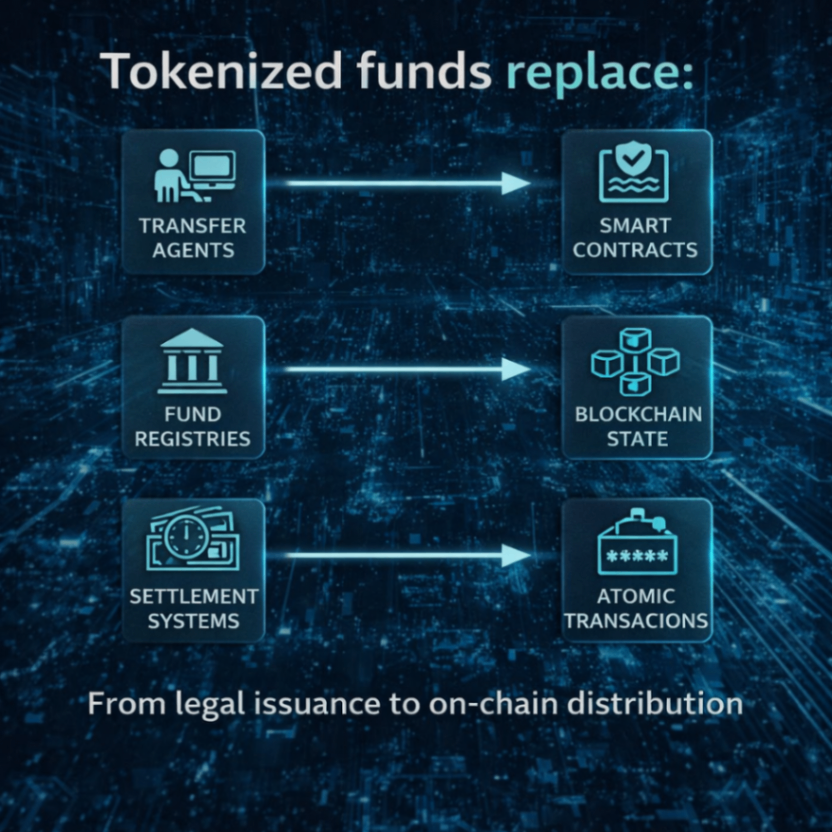
- transfer agents → with smart contracts
- fund registries → with blockchain state
- settlement systems → with atomic transactions
- distribution networks → with programmable access
These components can form a programmable stack, but legal ownership and operational responsibility still depend on the product structure.
What Tokenized Funds Actually Enable
At a surface level, you get:
- 24/7 trading
- instant settlement
- fractional ownership
But the real shift is deeper:
1. Capital Efficiency Becomes Continuous
Today:
- Capital sits idle during settlement cycles
- Liquidity is trapped in operational processes
With tokenization:
- Settlement is instant
- Capital is always productive
The effect depends on settlement design, operating costs, and the fund's underlying assets.
2. Funds Become Composable Financial Primitives
A tokenized fund combines an investment with programmable transfer and operational functions.
It becomes:
- collateral
- a building block for derivatives
- a programmable yield instrument
- a component inside other financial products
Funds evolve from products → into infrastructure
3. Distribution Becomes Global and Permissioned
Traditional distribution is:
- jurisdiction-bound
- intermediary-heavy
- slow to scale
Tokenized distribution is:
- wallet-based
- programmable (KYC, restrictions, compliance)
- globally accessible
This can connect on-chain capital with products that otherwise use traditional distribution channels.
The Real Opportunity: Connecting Two Worlds
There is a structural gap in markets today:
On one side:
- $2.5T+ in crypto capital
- limited access to real-world yield
On the other:
- $50T+ in traditional funds
- limited access to digital-native investors
Tokenized funds can connect these markets through an additional settlement and distribution layer without replacing either system.
Why Most Platforms Will Fail
Tokenization is not about minting tokens.
It requires solving four hard problems simultaneously:
1. Legal wrapper
Funds still need compliant structures (SPVs, funds, jurisdictions)
2. On-chain issuance
Smart contracts, token standards, lifecycle management
3. Compliance
KYC, AML, transfer restrictions, jurisdiction controls
4. Distribution + liquidity
Secondary markets, integrations, investor access
Most solutions solve one piece. The market requires all four.
The Full-Stack Approach
A tokenized fund platform must handle:
Issuance Layer
- Fund creation and structuring
- On-chain share representation
- Lifecycle automation
Compliance Layer
- Embedded KYC / AML
- Transfer restrictions
- Jurisdiction-aware logic
Tokenization Engine
- Smart contract infrastructure
- Asset abstraction layer
- Interoperability across chains
Distribution Layer
- Investor access
- Secondary transfers
- API-driven integrations
Wallet & Custody
- Institutional-grade asset control
- Hybrid custody (on/off-chain compatibility)
Why This Matters Now
Three developments are shaping the current market:
1. On-chain money is real
- Stablecoins
- Tokenized deposits
- CBDCs
2. Institutions are already moving
- BlackRock
- Franklin Templeton
- UBS
3. Infrastructure is finally usable
- scalable blockchains
- compliant frameworks
- production-grade tooling
The pace and timing of adoption remain uncertain.
Requirements for Adoption
Success depends on:
- controlling issuance infrastructure
- owning distribution rails
- embedding compliance into the protocol
The same way:
- ETFs reshaped asset management
- APIs reshaped fintech
- cloud reshaped software
The Bottom Line
Tokenized funds are one possible operating model for asset management.
- Funds will be issued on-chain
- Money will be programmable
- Distribution will be global
- Liquidity will be continuous
The practical question is which infrastructure, legal structure, and distribution model fit each fund.