How to build a Secure SSN Storage System and pass SOC 2 audit
This article describes a two-perimeter architecture for protecting Social Security Numbers (SSNs) with RSA encryption and Google Cloud security services.
How to build a Secure SSN Storage System and pass SOC 2 audit
Introduction to SOC 2 and Confidentiality
Service Organization Control Type 2 (SOC 2) is a cybersecurity compliance framework developed by the American Institute of Certified Public Accountants (AICPA). It evaluates controls that service providers use to protect client data. An independent auditor evaluates an organization's information security practices and issues a SOC 2 report describing the results.
The Five Trust Services Principles
The SOC 2 framework is built upon a foundation of five interconnected Trust Services Principles (TSPs): Security, Availability, Processing Integrity, Confidentiality, and Privacy. These principles define the criteria against which an organization's internal controls are evaluated.
- Security: This is the foundational and only mandatory principle for a SOC 2 audit. It broadly encompasses the protection of systems and data against unauthorized access.
- Availability: This principle ensures that systems meet their service level agreements (SLAs) for uptime and performance, requiring fault-tolerant design and disaster recovery planning.
- Processing Integrity: This criterion applies to organizations that process or manipulate customer data. It dictates that systems must function as per their design, producing accurate, complete, and timely outputs without errors or vulnerabilities.
- Confidentiality: This principle addresses the protection of data that is designated as confidential, ensuring that access is restricted to a specific group of authorized individuals or systems.
- Privacy: This principle governs the collection, storage, use, and disposal of personally identifiable information (PII). It mandates adherence to the organization's own privacy policies and the AICPA's Generally Accepted Privacy Principles (GAPP)
The Business and Technical Rationale for Prioritizing Confidentiality
The Confidentiality principle applies to organizations handling sensitive business information, such as source code, intellectual property, financial information, business plans, and passwords. Its requirements cover the lifecycle of confidential data and can be summarized as identify, protect, and dispose.
Including the Confidentiality principle in a SOC 2 audit evaluates how the organization protects sensitive data and documents those controls for customers and auditors.
Architecting for SOC 2 Confidentiality with Google Cloud
A cloud environment needs a security architecture aligned with the SOC 2 principles. Google Cloud Platform (GCP) provides services that can support the Confidentiality principle.
The following table maps GCP services to SOC 2 Trust Services Principles and the controls they can support.
| GCP Service | SOC 2 Trust Principles Supported | Technical Contribution |
|---|---|---|
| Cloud Key Management Service (KMS) | Security, Confidentiality, Privacy | Manages cryptographic keys, enabling data encryption at rest and key rotation policies. |
| Cloud Load Balancing | Security, Availability | Acts as an SSL endpoint, offloading encryption/decryption. Improves system uptime and performance. |
| Google Cloud Armor | Security, Availability | Provides a web application firewall (WAF) and DDoS protection. Guards against web application vulnerabilities and denial-of-service attacks. |
| Virtual Private Cloud (VPC) | Security, Confidentiality, Privacy | Creates isolated and secure network environments. Allows for environment segregation (e.g., dev, staging, prod). |
| IAM & VPC Service Controls | Security, Confidentiality, Privacy | Enforces the principle of least privilege. Defines security perimeters around resources to prevent data exfiltration. |
| Cloud Logging | Security, Confidentiality, Processing Integrity, Availability | Provides an immutable audit trail of API calls, resource changes, and user activity. Critical for proving the operational effectiveness of controls. |
| Sensitive Data Protection (DLP) | Confidentiality, Privacy | Identifies, classifies, and redacts sensitive data elements. Helps in monitoring and controlling access to sensitive data. |
Protecting SSN with RSA
SSN breaches can create regulatory, legal, and reputational consequences. This architecture uses RSA encryption and Google Cloud security services to protect SSN data across two perimeters.
How RSA Encryption Works
RSA is an asymmetric cryptographic algorithm that operates with two mathematically linked keys:
- Public Key – Shared openly and used to encrypt data. In our case, this allows SSNs to be encrypted securely at the point of entry.
- Private Key – Kept secret within a secure environment and used to decrypt the data. This ensures only authorized administrators can access the original SSN.
The crucial advantage of RSA lies in its one-way relationship: while the public key can encrypt data, it is practically impossible to derive the private key from it.
Dual-Perimeter Security Model
We separate responsibilities across two perimeters:
- User-faced perimeter – Protecting external connections, ensuring that SSNs are securely transmitted and encrypted at entry.
- Administration-faced perimeter – Allowing access to decrypted SSNs only to highly privileged administrators within a private network.
This model applies defense-in-depth through encryption, network isolation, and granular permissions.
End User Perspective: Secure Entry and Encryption
When a user submits sensitive data such as an SSN, it passes through a protected flow designed to stop threats and immediately encrypt the information.
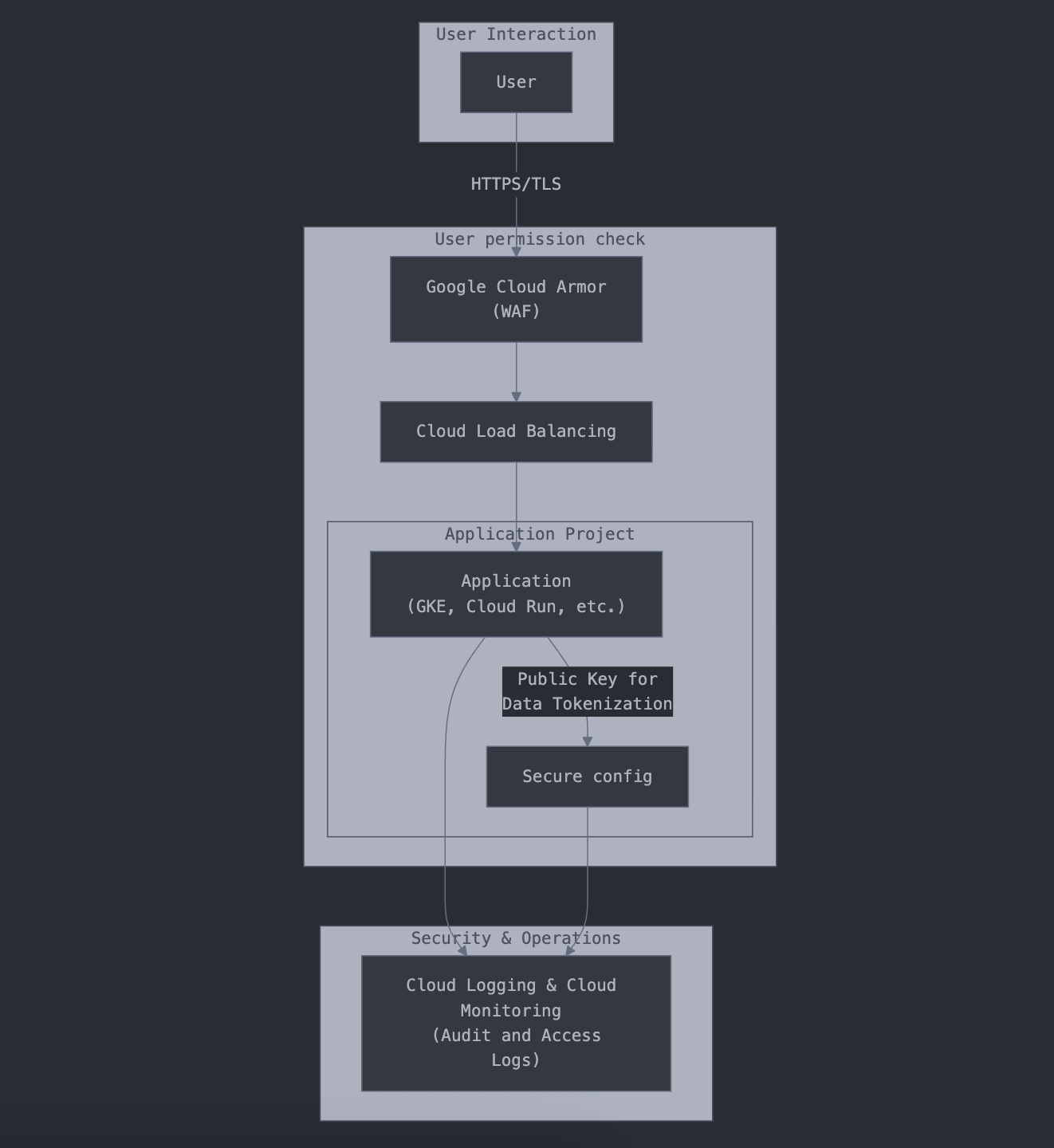
Key safeguards in this layer:
- TLS/SSL encryption secures all communication.
- Google Cloud Armor (WAF) blocks malicious requests at the edge.
- Application layer immediately encrypts SSNs using the RSA public key, ensuring plaintext SSNs are never stored.
- Audit logs track all access and encryption operations for compliance requirements.
Admin Perspective: Secure Decryption and Access
Decryption of SSNs is strictly limited to administrators who operate within a private network perimeter. This ensures exposure to decrypted SSNs never occurs over the public internet.
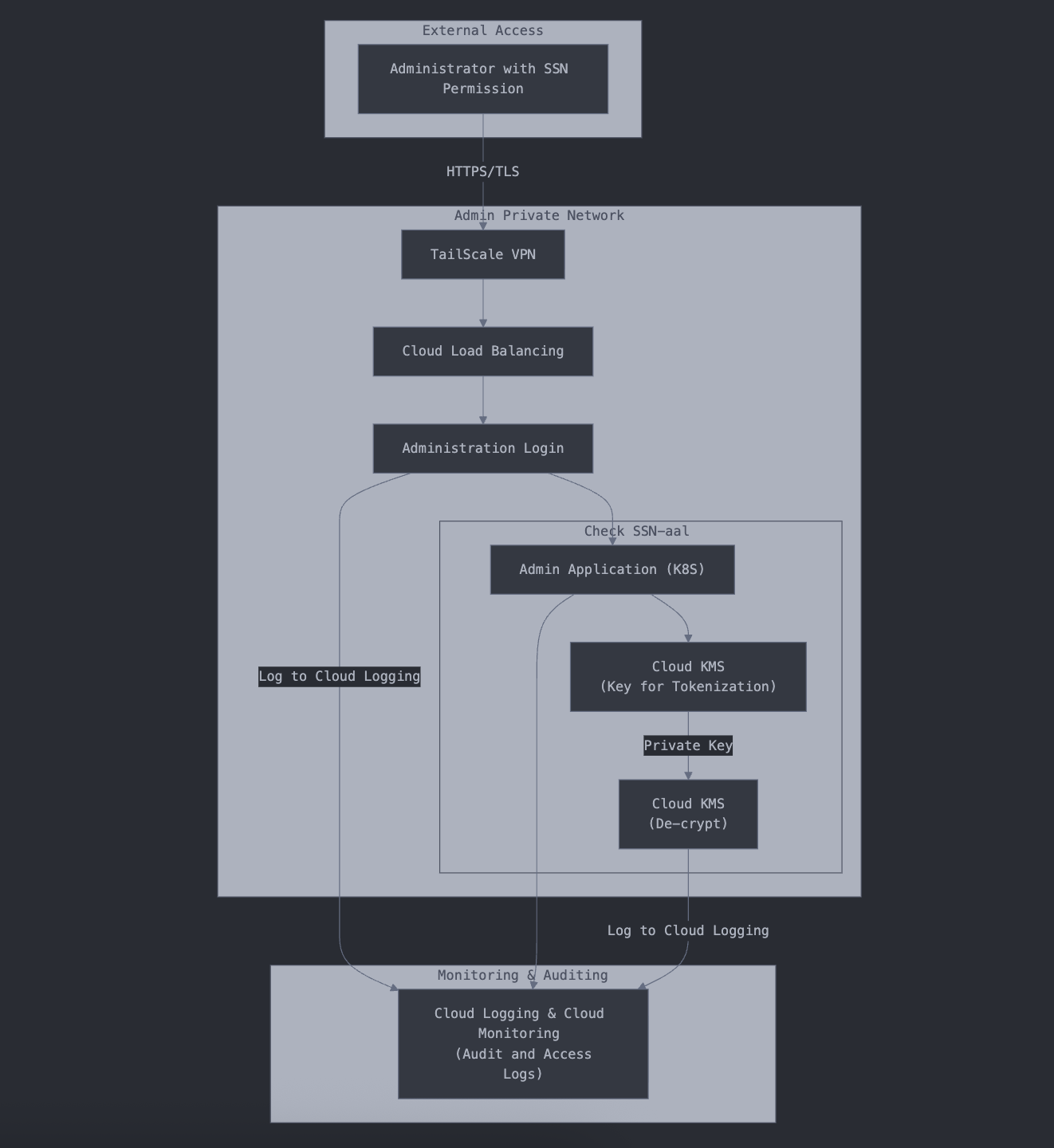
Key safeguards in this layer:
- TailScale VPN ensures admins connect only through a private, secured network.
- Granular permissions: only users with the right roles and credentials can request decrypted SSNs.
- Cloud KMS (Key Management Service) stores and manages the private key.
- Strict logging and auditing record every decryption event, providing accountability and compliance readiness.
- No direct internet exposure: the admin panel runs in a private cluster with no connection to the public web.
Defense in Depth
This dual-perimeter architecture ensures that:
- Users’ SSNs are encrypted on entry – no plaintext SSNs are stored or transmitted.
- Decryption only happens inside a private network – minimizing risk of exposure.
- Audit logs are comprehensive – every encryption, decryption, and access event is tracked.
- Keys are centrally managed with Cloud KMS – removing the risk of leaked credentials.
The architecture combines RSA encryption, private networking, cloud security tools, and operational controls to protect SSN data and support the documented SOC 2 controls.