CI/CD to release high-quality products at speed
How Continuous Integration and Continuous Delivery (CI/CD) support software releases
Many software companies today are using Continuous Integration and Continuous Delivery (CI/CD) to release high-quality products at speed
Many companies use Continuous Integration (CI) and Continuous Delivery (CD) to release software. A stable and reliable platform is important for any technical product or service. A CI/CD pipeline gives teams more control over what they deploy. Building one takes work, but the right automation strategy and tools can reduce manual effort.
In the tech industry, teams need to adopt suitable technologies and work practices. Smartphone manufacturer Nokia lost significant market share as it failed to adapt to newer technology – Android.
Most of you are probably familiar with the waterfall approach, a method in software development where you first develop, then test, then release. No processes overlap, and nothing happens in parallel. You start something and finish it before you go on to the next.

Continuous Integration and Continuous Delivery (CI/CD) is a DevOps practice that connects development, testing, and operations. Developers integrate changes regularly, tests run against those changes, and operations teams release updates more often. CI/CD can shorten release cycles and help teams ship functionality regularly. A well-designed process can also support product resilience and security.
CI/CD is an automated chain that reduces unnecessary manual work and errors. People still review changes and respond to failures. The pipeline checks for errors and notifies testers and developers when a build breaks or a change cannot merge.
Phases of CI/CD
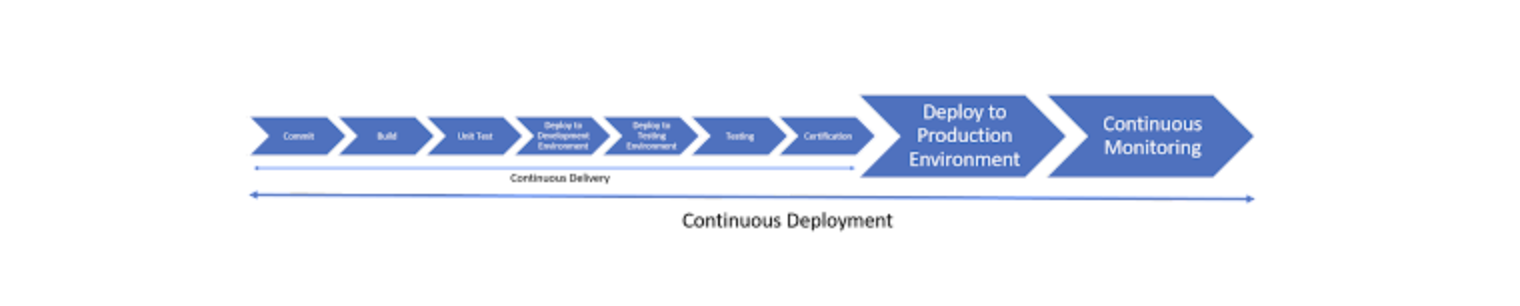
CI/CD pipelines often follow Agile practices. The major phases are:
Continuous Integration
- Commit: The developer commits code regularly to the version control system.
- Build: The code is then built using suitable build tools to obtain an artifact.
- Unit Test: The developer generally writes unit tests to test functionalities at ground level. These are run along with the build.
- Deploy to Development Environment: The build is then deployed onto a common Development Environment where devs can test how their code works when combined with other developers’ code.

Continuous Delivery
- Deploy to Testing Environment: Deployment to this environment happens once a development phase(sprint) is completed. The last successful build is deployed onto the Testing Environment. This environment will ideally be a mimic of the Production Environment.
- Testing: QA teams run various automated tests like Integration testing, Regression testing, Load, and Performance testing. This ensures that the product developed at the end of each sprint is ready to be released to the market.

Continuous Deployment
- Deploy to Production Environment: Ideally, this happens at the end of the testing phase in each sprint. But companies have preferred to take this step based on business strategy and needs.
- Continuous Monitoring: This involves monitoring the product’s performance, the underlying server status and ensuring the sanity and security of the Production Environment.
- Rollback: This entails the ability to roll back to a previous stable version of the product in case of any unfortunate issues.
Role of Automation Testing in CI/CD
To test functionality consistently, run tests on every build. Manual testing of every build is not practical, so automated tests are a core part of many CI/CD pipelines. They can detect bugs earlier, but they do not guarantee a bug-free release. Test automation can:
- Reduce manual effort when a test must run repeatedly. This frees QA time for other work.
- Give fast feedback.
- Support more regular updates by checking changes consistently.
Automated tests in a CI/CD pipeline can use real browsers and devices. Emulator and simulator tests can miss issues that occur only on real hardware.
How to build correct Automation Tests to fit in CI/CD pipelines?
Split tests into suites for different purposes. The following types fit into different CI/CD phases:
- Unit Tests: Many teams follow the Test Driven Development (TDD) approach. Developers write unit tests and run them during the build phase.
- Integration Tests: After each commit is built and deployed to the development environment, these tests check whether new modules and changes work together. Some organizations use a dedicated integration-test environment.
- Regression Tests: Teams may run regression tests nightly to check whether new changes affect existing code.
- Performance and Load Tests: Before production release, run tests in a UAT or pre-production environment to evaluate system responsiveness and stability.
- Security Tests is a process intended to reveal flaws in the security mechanisms of an information system that protect data and maintain functionality as intended.