June 2026 Development Update: Building the Operating Foundations
A tokenized fund is only as useful as the operating work around it. An investor still needs to be invited, identified, approved, funded, and recorded. A fund manager still needs to see which step is waiting, who owns it, and what evidence remains when a provider responds late. In June, we focused on those foundations.
Our work moved across the Tahoe application, fund administration services, settlement and wallet services, and shared infrastructure. The common thread was making a financial workflow easier to name and easier to hand between people and systems. That gives fund and fintech operators a more practical way to assess progress: follow the record from the first invitation through the resulting transaction, rather than looking only for a blockchain transaction.
Make onboarding a product workflow
We added the foundations of an investor portal with a dedicated layout, authentication store, redirect guards, and routes. We also changed the Tahoe vocabulary from “Profiles” and “Offers” to “Investors” and “Funds” in the manager experience. Clear language matters operationally: the screen should describe the accountable business object that a fund team is managing.
June also introduced a form-builder foundation with a field registry, drag-and-drop configuration, preview, rendering, autosave, uploads, and KYC-related hooks. That makes it possible to discuss onboarding as a configurable workflow instead of a collection of hard-coded screens. The current work includes mock and administrative data, so the foundation still needs integration before it can represent a complete onboarding path. The payoff for a COO is a clearer conversation about which information is required, where it is captured, and which team owns the next decision.
Give operations a joined-up view
Fund operations depend on visibility as much as on execution. We added invitation and administration paths in the fund-manager service, improved distribution reporting and execution views in the admin application, and added migration support for report status and a combined transaction view. Together, these changes make status and related transaction information easier to represent in the systems that operators already use.
The mechanism is straightforward but valuable: an invitation, a report, or a transaction can carry an explicit state that a person can inspect. The intended benefit is a better model for assigning work and investigating an exception from a common state record.
Treat settlement as a chain of accountable events
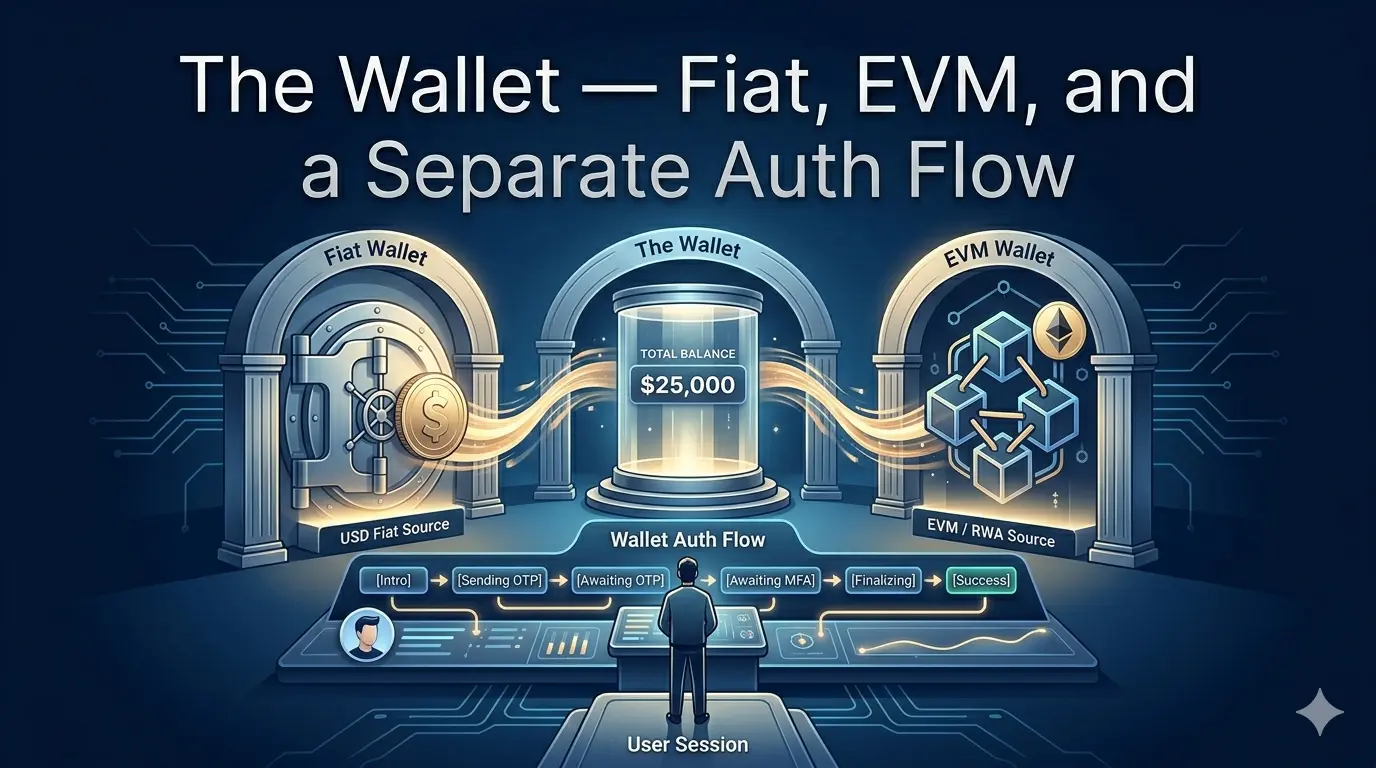
June connected several settlement and wallet steps. The EVM service gained a fiat-funded USDC settlement path, and its reconciliation process began publishing confirmed wallet-operation events. Turnkey wallet integration and follow-up fixes added the provider integration needed at the custody step. Wallet deduplication and email-worker changes then gave downstream consumers more context when an event is received and a confirmed operation needs to be communicated.
This is the right shape for a multi-provider financial workflow. A payment instruction, provider response, wallet operation, chain observation, and notification are separate events with different owners. Recording one event lets the next service act without pretending that all business work is complete. A confirmation remains one event in the chain; bank or chain finality and end-to-end exactly-once behavior require separate evidence.
Share the foundations across services
We also moved shared maintenance forward. The Go common package gained an ORM module, and shared models began moving onto it. This shared database-access layer gives services a consistent way to represent queries, repositories, saves, and transactions. In parallel, reusable monitoring configurations for Prometheus, Grafana, and Loki were added to the deployment repository.
These are enabling changes that make later workflow work easier to reason about because services share more of the same data and observability vocabulary. Our June development status is foundational: the pieces needed for a connected operating model are becoming explicit, while integration, environment validation, and accountable operational use remain to be verified.
For a fund manager or business partner evaluating the next step, the useful question is now concrete: for each investor and fund transition, which system is authoritative, who can approve it, and what evidence supports recovery when the next event is delayed? June’s progress gives us more places in the system to answer that question precisely.