Distribute Finance: Engineering Reliable Tokenization Software
Imagine you are reviewing a tokenized investment where the payment provider confirms the investor's cash and the blockchain confirms delivery of the asset, but the administrator's authoritative ownership record is still waiting to be updated. The investor sees success, the issuer sees received funds, and your operations team still has an unfinished obligation. Marking the investment complete because one provider responded would create a more dangerous problem than a visible delay.
This is the problem behind reliable tokenization software. A financial product crosses systems with different owners, timing, data, and definitions of completion. The platform must preserve what is known, control what happens next, and give a responsible person enough evidence to resolve what remains uncertain.
Distribute Finance is coordination across independent systems
We use Distribute Finance to describe the coordination of guarded business events across one financial lifecycle spanning independent banks, custodians, identity providers, blockchains, administrators, and other providers. It is not shorthand for DeFi, and it does not mean investment distribution alone.
Each participant performs part of the operation. An identity provider can return eligibility, a bank can confirm funds, a blockchain can provide transaction evidence, and an administrator can update the authoritative ownership record. None of those observations, on its own, proves that the investment is complete.
At Global Torque, the complete lifecycle model connects guarded business events, intent, validated facts, evidence, pending work, and exceptions across providers. Torque Flow is the durable business-process owner for that lifecycle. Supported workflows and integrations depend on the chosen setup and its connected providers.
That gives executives a simple question for each investment: what was requested, what is proven, what remains, who acts next, and what happens if a provider never answers?
Give each investment a durable home
A subscription may remain active for hours or days and must survive a closed browser, a restarted worker, a late callback, a provider outage, and a software release. Store it as a durable process with an identity, instrument rights, quantity, amount, currency, counterparties, workflow and policy versions, requirements, history, and next actions. Make the difference between a request, an observation, and a completed obligation visible to you and your operations team.
Each boundary needs a local guard: the owning service checks authorization, the applicable policy and prerequisites, authoritative current records, the operation identity, and conflicting or duplicate effects. The service commits its valid local result and accepted business fact together. That local transaction does not atomically commit an external bank or blockchain action.
For a given product and route, those guards may require evidence that:
- the investor's identity and eligibility were checked under the applicable policy;
- required documents and issuer approvals were accepted;
- cash reached the required settlement state in the specified currency;
- the correct asset quantity was delivered through the permitted route;
- the designated authoritative ownership record was updated; and
- the cash, asset, and ownership records reconcile.
Requirements may run in parallel or depend on earlier results. Bank transfers and blockchain transactions have different settlement rules; a blockchain confirmation is not automatically final cash settlement or ownership registration.
Your platform may show an overall lifecycle view, but it should derive that view from accepted local facts after each required boundary has guarded and recorded its transition. There is no universal completion flag for downstream services to obey. A successful API response or status from one participant cannot authorize another service's financial effect or satisfy the whole lifecycle.
Separate intent, facts, and views
Three concepts keep the workflow understandable. A command expresses intent: approve a subscription, request a payment, reserve funds, or deliver an asset. It is not proof that the action happened; the owning service checks its authorization, policy, prerequisites, current records, operation identity, and duplicate effects.
An event records an accepted local fact: eligibility was approved under a policy version, payment was confirmed against a provider reference, or asset delivery was verified. The producer validates and commits that local result and fact together. A callback becomes a fact only after authentication, correlation, validation, and reconciliation; it can arrive late, twice, out of order, or after a timeout.
A receiving service reloads the authoritative state it owns and independently guards whether the fact authorizes its owned command. It records its accepted result, deduplicates the effect, and uses a fenced claim around the reaction. It does not act merely because an upstream status says “done,” and an event does not replace database, API, or ownership truth.
For example, a payment fact can be valid at the cash boundary and still fail to authorize issuance. The receiving issuance service must reload eligibility, current policy, instrument availability, and asset reservations. If one guard fails, it records its pending or rejected local result instead of issuing. A derived view follows those accepted facts; it does not make the issuance decision.
A read model or projection translates facts into a view. You may see “Finalizing ownership records,” while your operator needs the pending action, evidence, deadline, and responsible person. The dashboard is not the authoritative ownership record. This is event-based architecture, not automatically event sourcing: a database change is not necessarily a business fact, and rebuilding a read model must never resend a payment, mint, or transfer.
Record the next action before leaving the database
A critical failure can happen after the local state change commits but before the system records that another service must be notified. The transactional outbox pattern closes that boundary by saving the state change and outgoing publication record in one transaction. A relay forwards it after commit and may duplicate it, so consumers need a stable effect identity and safe repeat policy. AWS's transactional outbox guidance describes why the transaction and relay have separate responsibilities.
Our workflow extends that idea to durable actions and accepted business facts. A worker can recover pending work after a restart. Each consequential action needs a stable identity, intended effect, amount and currency where relevant, provider reference, attempt history, and explicit outcome. The current outbox is a reaction lane for owned commands; the retained business journal preserves history. The journal does not drive every reaction, and clearing a queue entry must not erase investment history.
Treat an unanswered request as an unknown outcome
Suppose a provider accepts a payment request, but the response never reaches the platform. A timeout proves only that the answer is missing. It does not prove that the payment failed. Record UNKNOWN, retain the operation identity and request details, and reconcile the provider before attempting an irreversible effect again.
Retries preserve the same stable idempotency key. A changed amount or recipient must not silently reuse the original instruction's identity. Provider support, retention, and non-retryable outcomes still matter. Amazon's guidance on idempotent APIs explains why request identity has to express intent, not just protect a network call.
Recovery should be bounded. Use timeouts, backoff, jitter, and attempt limits, then move unresolved work to a named exception owner. If the provider cannot support a safe retry, reconcile or escalate.
When a later step cannot proceed, a saga can coordinate local transactions and compensating actions. A compensation is a new authorized corrective operation with its own evidence and possible failure; it does not undo a distributed world as if every provider shared one rollback. AWS's saga orchestration guidance describes that boundary.
| Situation | Safe workflow response |
|---|---|
| Payment response times out | Record UNKNOWN, reconcile the provider, then decide whether a retry is safe. |
| Payment is confirmed, but the issuance guard fails | Preserve the cash fact, record the local pending or rejected result, and resolve the missing eligibility, policy, availability, or reservation evidence before issuing. |
| Cash and asset delivery are confirmed, but ownership registration waits | Preserve the facts, keep completion pending, and assign the registration exception. |
| An irreversible effect may already have happened | Establish the authoritative outcome before resubmitting; use a separately authorized correction when needed. |
Keep policy, settlement, and ownership explicit
Policy decisions need their policy version, effective date, evidence references, result, reason, and required approval. The Policy Compiler makes those decision boundaries explicit. A later policy change should not make an earlier decision impossible to interpret. Legal and compliance specialists approve the requirements; software preserves the decision and applies the permitted workflow.
The Settlement Intent describes the intended exchange: asset, quantity, currency, counterparties, permitted rails, expiry, and confirmation evidence. It defines what the system coordinates; it cannot make independent bank and blockchain operations atomic by declaration.
The Asset Registry distinguishes issued, held, reserved, and moved units. A unit reserved for settlement cannot also appear available for another delivery, and an omnibus position plus its underlying allocation cannot be counted as two issuances. A technical token is not the legal right it represents; liquidity depends on permission, counterparties, custody, pricing, and settlement.
Payment and delivery can be accepted as separate facts while authoritative ownership remains pending. A UI projection may catch up before or after the register changes; neither view timing determines completion.
Build for change, then verify operations
Maintainability follows the same ownership model as reliability. The lifecycle owner coordinates; specialist services own identity checks, payments, custody, and chain execution. Provider adapters isolate transport, authentication, errors, and callback mapping, while exposing differences in finality, reconciliation, and recovery.
Workflow definitions, product policies, and event schemas need explicit versions. An unfinished transaction must survive an upgrade with a deliberate compatible path. Historical decisions must remain interpretable after the software changes, and replayed projections must not repeat an external effect.
The platform’s owned capabilities are independently deployable modules. A supported module can be added or removed without downtime or a platform rebuild, while each active transaction continues to follow its compatible path. The modular architecture article shows how that release model supports new products, providers and channels.
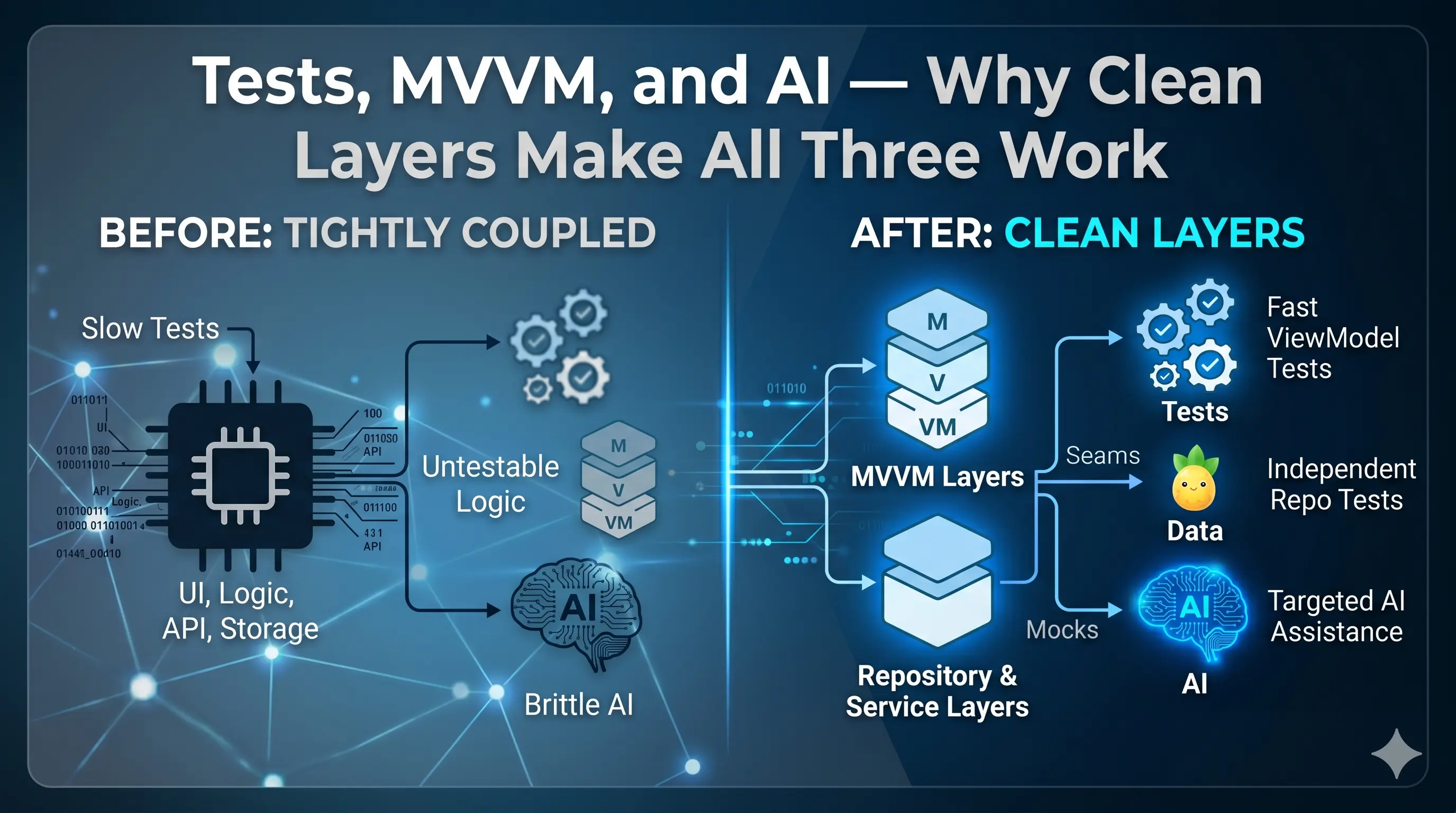
The same separation helps the frontend: views display state, while data adapters own provider communication. MVVM in practice explains how that boundary isolates changes.
Infrastructure supports the model; it does not prove financial correctness
Our documented development event model treats PostgreSQL and service APIs as authoritative. Committed outbox records are published through Debezium to separate consumers. The business journal, queue, and notification flows remain distinct; this is not evidence of a fully deployed event-sourcing platform. Delivery lanes have configured, lane-specific retry, dead-letter, and authentication behavior, not universal ordering, exactly-once processing, or completed financial outcomes.
Shared deployment automation supervises containers and configures resource and health behavior. Cloud Run includes startup and health checks and bounded resources. Production infrastructure guards environment selection and immutable image digests, while image publication is separate from rollout. Encrypted off-host backups and isolated restore-drill scripts support recovery.
Business instrumentation should expose backlog, unknown-outcome age, reconciliation breaks, and owned exceptions. Confirm the metrics configured for each deployment.
These controls support operations, but do not establish high availability, zero data loss, automatic undo, or a successfully completed transaction. The business test remains whether the right records, permissions, evidence, and accountable actions produce the right outcome.
Make reliability an executive test
The strongest reliability claim is an observable test. In a controlled, non-production rehearsal, walk one complete lifecycle through a delayed callback, verify that payment or mint is not duplicated, update the authoritative ownership record, release a compatible version, restore relevant state, and reconcile the result. Show what each investor, operator, and engineer can prove.
Measure pending-action age, unknown-outcome time, reconciliation lag, and manual touches alongside service availability. Define the population, period, baseline, and method. Availability alone cannot explain whether an investor's transaction is progressing.
For an existing platform, introduce lifecycle records, compare derived outcomes with current behavior, and move one mature workflow at a time. Validate each deployment by demonstrating business invariants, recovery paths, release compatibility, and evidence in the intended environment.
Distribute Finance gives tokenization software a practical standard: preserve the financial facts, control the next action, and make every unresolved obligation visible. If you are planning a tokenization platform, talk to our team about mapping one complete financial workflow, including its recovery paths and release criteria.